
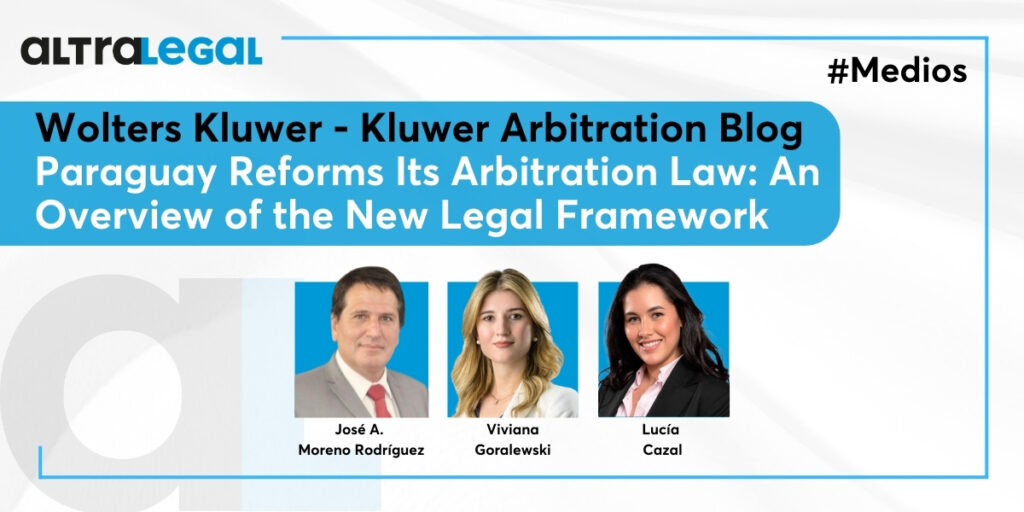
After more than two decades under Law No. 1879/2002, Paraguay has enacted Law No. 7561/2025, substantially overhauling its arbitration framework. The reform aligns Paraguayan law with the 2006 UNCITRAL Model Law and reflects comparative developments across Latin America and Europe.
The analysis published in the Wolters Kluwer Arbitration Blog — authored by José Antonio Moreno Rodríguez, Viviana Goralewski Hempel and Lucía Elena Cazal Zaldivar of Altra Legal — provides a systematic overview of the reform’s main innovations. The new law significantly expands arbitrability, adding categories such as succession disputes with heirs’ consent, disputes involving professional athletes, and — expressly — the ability of State entities to submit to arbitration, except in purely public law matters.
A central pillar of the new regime is the precise delimitation of judicial intervention. Courts may only act in cases expressly enumerated by law: assistance in taking evidence, adoption or enforcement of interim measures, annulment proceedings, and recognition of foreign awards. Outside these cases, judicial interference is expressly prohibited. The law goes further: it grants arbitral tribunals the authority to directly enforce their own interim measures, confining courts to a strictly auxiliary role, with no power to review the merits of the measure ordered.
On applicable law, the reform introduces a more flexible approach: absent a choice by the parties, the arbitral tribunal may directly apply the law it deems appropriate, without recourse to conflict-of-laws rules — a position consistent with modern international arbitration practice.
The annulment regime retains a single remedy against awards, with grounds closely tracking Article 34 of the Model Law, adding late issuance of the award as an optional contractual ground. The law distinguishes timeframes for domestic (15 days) and international (25 days) cases, and regulates in detail the consequences of setting aside an award depending on the nature of the defect.
As the authors note, the true measure of this reform’s success will lie in its judicial interpretation and practical application in the years ahead. The legislative design is solid; the challenge, as always, is implementation.
Full analysis by José Antonio Moreno Rodríguez, Viviana Goralewski Hempel and Lucía Elena Cazal Zaldivar at the Wolters Kluwer Arbitration Blog: https://legalblogs.wolterskluwer.com/arbitration-blog/paraguay-reforms-its-arbitration-law-an-overview-of-the-new-legal-framework/